Book with Flowers Embroidery Design
A Quiet, Thoughtful Design That Earns Its Place
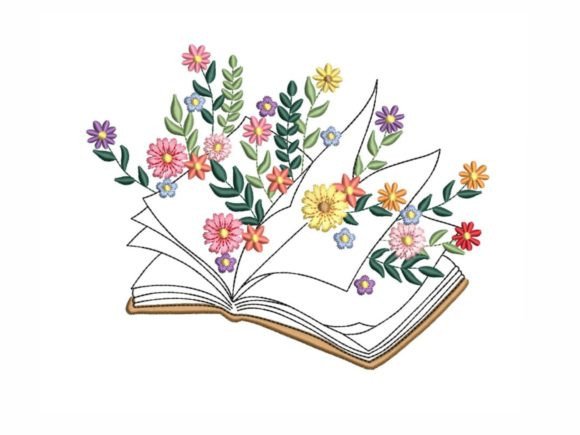
When I first opened Book with Flowers, I didn’t see a “cute” motif or a trendy clipart-style graphic—I saw something that breathed. It’s soft without being saccharine, detailed without feeling fussy, and literary without leaning into cliché. The composition balances weight and air: the book sits grounded, its spine gently curved, while blossoms rise and trail in loose, organic motion—some open, some budding, one or two even drifting just off the edge. This isn’t a rigid emblem; it’s a quiet narrative stitched in thread. As a designer who’s evaluated hundreds of embroidery files for real client work and small-batch production, I immediately asked: *Where would this feel essential—not just decorative?*
Where It Shines in Real Projects
Last week, I used Book with Flowers to embroider a linen tote bag for a local indie bookstore’s staff gift set. No monogram, no logo—just the design centered on the front panel, 4.2" wide, stitched in matte cotton thread on natural flax. The result was instantly cohesive: warm, intentional, and quietly confident. Customers paused to look. Staff wore them proudly. That tells me more than any spec sheet could.
The design naturally anchors itself in thoughtful contexts: baby onesies (paired with pale mint or oatmeal thread), tea towels for a teacher’s welcome basket, pillow covers for a school library nook, or framed embroidery art for graduation gifts. It works beautifully as an embroidered patch on denim jackets—especially when backed with lightweight fusible web for stability—and holds up well on structured sweatshirt fabric, where fill stitch density stays balanced and satin-stitched petals retain shape without puckering.
For Etsy sellers and craft fair vendors, Book with Flowers is a subtle brand builder. It reads as handmade, not mass-produced. When paired with clean typography in a printable mockup—or styled beside a stack of vintage paperbacks and dried lavender—it elevates perceived value. Buyers don’t just see a design; they sense care, literacy, and calm creativity.
Where to Pause and Plan Ahead
This isn’t a “drop-and-stitch” file for every surface. On thin cotton tees or stretchy jersey, the floral elements near the book’s corners can blur if stabilizer isn’t layered thoughtfully—especially where delicate stems meet tighter curves. I recommend medium-weight cutaway + tear-away combo for anything with movement or frequent washing (think baby bibs or kitchen towels).
Caps and curved surfaces require extra attention. The book’s base sits flat, but trailing blooms extend outward—if you’re stitching on a structured cap front, test placement carefully. You may need to rotate or slightly scale down to keep petal tips from falling into the curve where stitches distort. Likewise, dense fill areas (like the book’s cover texture) benefit from reduced stitch density if your machine tends toward heat buildup on synthetics.
Dark fabrics demand contrast testing. The original Book with Flowers embroidery file likely assumes light-to-mid backgrounds—but on navy or charcoal, light-thread versions can fade visually. Try stitching a small sample in ecru, heather grey, and deep olive to see which gives clarity *and* warmth. And always check tiny details: are those flower centers legible at 3" wide? Does the spine’s subtle texture read, or does it collapse into a blob? Zoom in on your embroidery software before sending to the hoop.
Design Integrity Meets Commercial Practicality
What makes Book with Flowers stand out among School-category embroidery designs is its restraint. It avoids overused tropes—no apples, no chalkboards, no cartoonish graduation caps. Instead, it honors learning as something tender, living, and personal. That resonates across audiences: teachers appreciate its dignity, parents love its gentleness for nursery decor, and students respond to its quiet confidence.
For commercial embroidery, licensing matters. If you plan to sell finished items (like embroidered aprons for a teacher appreciation shop) or resell digital embroidery files, verify whether Book with Flowers includes small business or extended commercial use rights. Don’t assume—check the seller’s terms before listing on Etsy or bundling into a craft kit.
Designer Notes You’ll Actually Use
- Always stitch a test on scrap fabric—especially with textured weaves like burlap-blend tea towels or nubby linen.
- Review stitch density in your editing software. If fill areas exceed 18–20 stitches/mm², consider lightening density for breathable fabrics.
- Confirm hoop size compatibility. Does the full design fit comfortably within your most-used hoop—or will you need to split it for larger formats?
- Inspect small details at 100% zoom: petal edges, stem taper, book page lines. Are they crisp or overly simplified?
- Test black-and-white mockups—not just color. Many buyers browse in grayscale thumbnails.
- Compare light and dark fabric previews side-by-side. Does the design retain personality on both?
- Use proper stabilizer for your fabric type—cutaway for knits, tear-away for stable wovens, wash-away for sheer overlays.
- Ask yourself: Does this support my brand voice? Would I gift it? Would a customer recognize its meaning at a glance?
Final Thought: A Design That Grows With You
Book with Flowers doesn’t shout. It invites. It fits seamlessly into a craft business that values depth over decoration, and a handmade product line that trusts customers to feel nuance. Whether you’re stitching a single personalized gift or scaling for boutique wholesale, this embroidery design earns its space—not because it’s flashy, but because it’s considered, cohesive, and quietly memorable. In a market flooded with generic motifs, that kind of integrity is rare. And worth every careful stitch.